
If you’ve ever overcooked a piece of salmon, you’re not alone.
Even the most experienced cooks have overdone this pink fish at some point. But once you make that mistake, you don’t want to repeat it, and our aim here is to help you meet that goal.
Below, we explain four easy ways to tell if salmon is cooked.

Check the flakiness: Is it flaky?
How to know when salmon is done? Expert cooks can tell if a salmon is done by its flakiness. Salmon should be flaky when it’s fully cooked. Under high heat, the flesh of the fish will become firmer and the natural oils in the fish will begin to separate from the flesh, resulting in a flaky texture.

To check if your salmon is flaky, use a fork to gently pull the flesh apart.
- If the flesh easily separates into large, firm flakes, then the salmon is fully cooked.
- If the flesh still looks translucent and doesn’t flake easily, then it means that more time is needed.
It’s important to note that overcooking salmon can cause the flesh to become dry and tough, so it’s best to remove the salmon from the heat, slightly before it’s fully cooked and allow it to rest for a few minutes to finish cooking. It’s also important to keep in mind that thicker cuts of salmon require a longer cooking time.
Check the temperature: Salmon is cooked at what temp?
The United States Department of Agriculture (USDA) recommends cooking salmon to a safe internal temperature of 145°F (63°C). The USDA recommends this temperature for all fish and shellfish, which is well-done. However, for the best flavor and texture, it’s best to cook salmon medium-rare, which is 120° to 125°F (49° to 52°C). You may not want to risk cooking it to this temperature, but the flesh of the salmon should be opaque and easily flake apart, even at medium-rare.
To check the internal temperature of the salmon, you can try an instant-read thermometer like the Typhur InstaProbe™.
Highlights of Typhur InstaProbe™ instant-read meat thermometer:

- It is the fastest meat thermometer on the market, with a lightning 0.75 seconds response time.
- Accurate to ±0.5℉, with 7 different temperature points calibration (certified by NIST), for reliable reading in any cooking situation you can imagine.
- It’s also waterproof with built-in magnets, so you can wash it in the sink and stick it onto your fridge anytime you want.
Using the Typhur InstaProbe™ to get instant temperature reads
Step 1. Insert the probe of the Typhur InstaProbe™ into the thickest part of the salmon fillet, making sure not to touch the bone. If the salmon has skin on, insert the probe through the skin, into the flesh.
Step 2. Wait just 0.75 seconds, and the Typhur InstaProbe™ will give you the exact temperature.
Step 3. Once the salmon has reached the recommended internal temperature, remove it from the heat and let it rest for a few minutes.
Want to know more about Typhur InstaProbe™? Please have a look at this video. You will be surprised!
Note:
As with checking the salmon’s doneness with the flakiness test, when you’re using an instant read thermometer it’s also recommended to remove the salmon from the heat when it’s a few degrees below the desired internal temperature, and then allow it to rest for a few minutes to finish cooking.
Check the color: What color is cooked salmon?
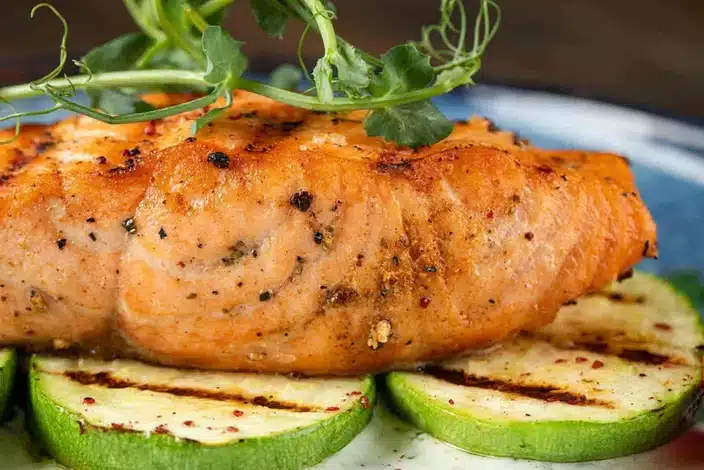
Cooked salmon should be opaque and have a light pink or coral color, depending on the type of salmon. For example, wild salmon tends to have a brighter, more vibrant color compared to farmed salmon. But no matter what type of salmon you’re cooking, the flesh of the salmon should be evenly colored and not have any translucent or raw-looking parts. Overcooked salmon may appear dry, white, or faded in color, and may have a tough texture.
While color can be a helpful visual indicator of doneness, it’s not always reliable. To ensure that salmon is fully cooked and safe to eat, it’s best to use a meat thermometer to check the internal temperature.
Check the time: How long does it take to cook salmon?
The cooking time for salmon depends on the thickness of the fillet you use and how you are cooking it. Salmon should be cooked for about 10 minutes per inch of thickness when cooked at 375°F (190°C).
Cooking times can change based on the specific oven, grill, or stove being used, as well as the thickness and starting temperature of the salmon. To ensure that the salmon is fully cooked, it’s best to use a meat thermometer to check the internal temperature.
FAQs about cooked salmon
1. Can you eat undercooked salmon?
It is not recommended to eat undercooked or raw salmon. Consuming undercooked or raw salmon can put you at risk of foodborne illness, specifically an infection with the parasite known as Anisakis. Symptoms of Anisakis infection can include nausea, vomiting, diarrhea, abdominal pain, and in rare cases, an allergic reaction.
Additionally, consuming undercooked or raw salmon can also expose you to harmful bacteria, such as Salmonella or Vibrio.
2. Is it OK if the salmon is pink in the middle?
Yes, it is okay for salmon to be pink in the middle. The pink color of cooked salmon comes from astaxanthin, a natural pigment that is found in salmon and other seafood.
Astaxanthin does not break down at cooking temperatures and will remain pink even when salmon is fully cooked (it’s responsible for the red color you get when you cook shrimp and lobster).
Conclusion
How to know if salmon is cooked?
Simply use the 4 methods mentioned above!
Remember, the temperature is the main factor of whether your salmon comes out the way you want. So, make sure to cook salmon to the appropriate internal temperature, it is recommended to use the best instant-read meat thermometer, like the Typhur InstaProbe™.
Sous Vide Beef Ribeye Steak(Jason)
Equipment
- Typhur Sous Vide Station
- Vacuum Sealer
- Vacuum Seal Bag
- Lin_test_addd
Ingredients
For Sous Vide Cooking:
- 8.8 oz Beef Ribeye bone in or boneless
- Kosher Salt
- Fresh Cracked Pepper
- 1 tbsp Extra virgin Olive Oil or unsalted butter
- 2 sprig Fresh Thyme
- 1 each Garlic Clove whole, skin on, crushed
For Searing the Ribeye:
- 1 tbsp High Temperature Oil: canola oil, grape seed oil, avocado oil
- 1 tbsp Unsalted Butter for basting, can be substituted for oil
- 1 pinch Fleur de sel
Instructions
- Add enough water to the tank to ensure that the ingredients are fully submerged and the minimum quantity of water is reached. Complete set up by securing the sous vide cooker to the tank.
- Generously season the steak with salt and pepper before placing it in the vacuum bag along with olive oil or unsalted butter, garlic, and a sprig of thyme or rosemary.8.8 oz Beef Ribeye, Kosher Salt, Fresh Cracked Pepper, 1 tbsp Extra virgin Olive Oil, 2 sprig Fresh Thyme, 1 each Garlic Clove
- Using the handheld vacuum sealer, make sure that the ribeye is completely sealed and that any excess air has been removed from the bag.
- Secure the magnetic weight to the bottom of the sous vide bag before carefully lowering it into the water bath. Secure the sous vide bag by inserting the bag clip into the rack.
- Select the thickness of your steak followed by your preferred doneness. Preheat water until reach the target temperature, then place the food in and cook the food until ready.Thickness: 1 inch Freshness: fresh Time: 1 hour, 17 minutes

- Remove the steak from the bag along with the herbs and garlic to a paper towel-lined plate or a sheet tray with a roasting rack. We suggest allowing the steak to cool down uncovered in the refrigerator for 15 minutes. You can also place the entire bag with the steak still sealed inside into a large ice bath. Cooling the steak down will prevent overcooking after the steak is seared.
- Once the ribeye has finished cooking, carefully remove the steak from the water bath.
- Place a sauté pan over high heat and add 1 tbsp (14g) of high-temperature cooking oil. When the oil begins to lightly smoke, carefully add the steak along with the garlic and herbs to the pan. Sear the steak on each side for approximately one minute. After flipping the steak,you can add 1 tbsp (14g) of unsalted butter for basting. This adds an extra depth of flavor and smells amazing!
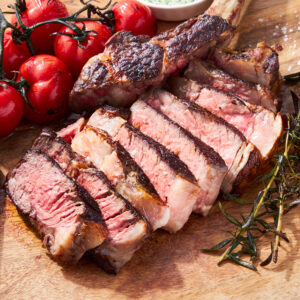
- The ribeye can be enjoyed whole or thinly sliced. For added flavor and texture, we suggest finishing with a pinch of Fleur de sel or flaky sea salt.1 pinch Fleur de sel